The RPG blogging community continues to grow, evolve, and refine itself. Last year we saw the RPG Bloggers Network go live and millions of bloggers stampeded to get in on the action (ok... maybe not millions). Then, the RPG Blog Carnival was started, and we all began to work together by blogging together about shared topics. And of course, we all know about my other project... OPEN GAME TABLE, and Anthology that hopes to highlight the best in the RPG blogging community.
But, where are all these bloggers? Ed Healy suggested we all let each other know our real-world locations so that we could cover conventions, have meet ups, plan bigger projects, and just generally take over the whole gaming industry (OK... what was in my last cup of coffee). So, I now present you a growing map to the world with the location of where we EXIST.
View Larger Map
As you can see, we are spread out all over the place, but we band together daily nonetheless. Are you an RPG blogger? Then add your thumbnail to the map! Is there a convention missing that should be added to the map? Then add one to the map!
What new, great, aweshum, schoewKewl project will the RPG blogging community come up with next? What does 2009 have in store for us? Please DO TELL!!!
January 8, 2009

January 7, 2009
OPEN CALL FROM GOODMAN GAMES!

It seems the indy game industry is slowly ramping up to embrace 4E Dungeons & Dragons, with or without signing the GSL. The latest addition to the fray is an announcement today from Goodman Games that
"This is an open call for 4E game designers who want to contribute to Book of Rituals, a hardback compilation that will see print in the fall."It's a paid gig, and they are looking for both amateurs as well as professionals. So, if your looking for a way to test the RPG publishing waters, this might be just the ticket. I know I'll be submitting a few. I mean... why not!?
... Wow it's been a busy week
The Skill Challenges of War - Part 12: Forcing a Surrender
The Skill Challenges of War is an ongoing series here at The Core Mechanic written by me, and two excellent guest bloggers: MadBrew and Gamefiend. Please check out the previous posts in the series and let us know what you think or if you are planning on using any of these skill challenges in your game. Previous articles in the Skill Challenges of War series are under the label WAR.
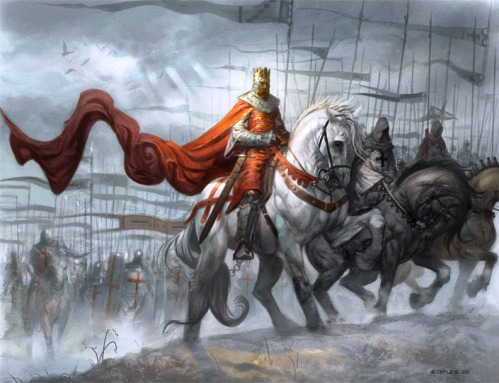
You vastly outnumber the enemy, but they have managed to build an effective defensive perimeter and are not going to surrender easily. Your choices are to completely annihilate them at a potential great cost to your own soldiers lives, or force them to a surrender through by other means.The PCs and their company have managed to corner the enemy, although the final stretch of victory escapes their grasp. The enemy has holed up in defensive location that has proved nearly impossible to force them out of. The PCs must decide to either make one last and bloody push towards victory, or suddenly change tactics and possibly get the enemy to lay down their arms.
SETUP: You must get the enemy to abdicate their position either by destroying them or forcing a surrender.
LEVEL: The PCs’ level +1.
COMPLEXITY: 2 (6 successes before 3 failures).
PRIMARY SKILLS: Bluff, Diplomacy, Insight, Intimidate, Stealth.
Bluff (Hard DC): The PCs and their forces feign a withdraw from the area in the hopes of drawing the enemy out into the open. A success indicates the enemy sends a scouting party out to assess the situation. If the PCs choose to continue baiting them, then this opens up a Stealth check to remain undetected and possibly bring forth the entire enemy force from their positions. Alternatively, if the scouting party is attacked and destroyed, this counts as a second automatic success for the challenge and provides a +2 bonus to the next next skill check. A failed Bluff check indicates the enemy senses your ruse and continues to defend their position. A failure also places a -2 penalty on any future attempts at using Bluff in this way.
Diplomacy (Moderate DC): After heavy losses on both sides, the PCs decide to parlay with the enemy to attempt a reasonable discourse. A failure using this method indicates the enemy is either willing to fight to the death, or that they do not trust the PCs enough to lay down their arms. A success not only counts towards the challenge, but also opens up Insight to be used for additional successes.
Insight (Moderate DC): The PCs skill with negotiations proves an advantage and they manage to gain some key insight into the enemies motivations or goals. A success does not count towards the challenge, but allows the next use of Diplomacy to count as either two successes or no failures (on a failed Diplomacy check).
Intimidate (Hard DC): The PCs and their company make a terrifying show of force just beyond the reaches of the enemies most skilled archers. Knowing the end is coming, his weakens the hearts of the enemy and forces some to desert their positions. A success indicates that some of the enemy soldiers desert their positions and flee the area (to be later captured by the allied forces). A failed attempt only hardens their hearts pushes them to fight to the death.
Stealth (Hard DC): The PCs send in an assassin to kill the commanders of the enemy troops. A success indicates the mission was a success and one of the mid-level commanders has been killed. A failure indicates that the assassin was found and captured, placing a -2 penalty on further attempts to use Stealth and prevents any further effective use of intimidation to get them to surrender.
SUCCESS: The PCs are victorious and either force or negotiate a surrender of the enemy forces, which are all taken into custody.
FAILURE: The PCs fail to get the enemy to lay down their arms and must destroy them through attrition. Their overwhelming forces guarantee a victory, but at great cost. Each PC will use all their daily powers and encounter powers during the battle, and the next Skill Challenge of War will suffer from a -2 penalty on any skill check that relies on force strength for successes.
Got something else to add to this skill challenge? Let me know by leaving a comment!
January 6, 2009
REVIEW: The Kobold Guide to Game Design, Vol. II - How to Pitch, Playtest & Publish

Open Design recently asked that I review Chapter 6: Promises, Promises: The Art of the Pitch for their recently released second volume of The Kobold Guide to Game Design by Wolfgang Baur. Honestly, I loved the first edition on Adventures. Owning the hard-copy allowed me to sit on my back-deck and soak it up leisurely over a period of a week or so. I had few complaints, and have recommended it to many DMs since as a 'must-read'. As far as the second volume of the book is concerned, I can't comment on the entire contents of the book (my printed copy has yet to arrive), so this review will be limited just to the chapter I was provided by Open Design. In short, Chapter 6 maintains the same high standards of insight as the previous edition of the book would lead me to expect, but I'm afraid that its appeal overall is limited to a more narrow audience.
This chapter opens with an emphasis on the setting the two fundamental rules of pitching an adventure, story, campaign setting, or whatever you might be interested in: don't be a bore; and know thy audience. These two bits of advice may seem obvious, but the Baur writes with enough wit that it remained an entertaining read nonetheless. He goes into some detail about having a thick skin as a writer, be prepared for rejection, and most of all write what you love. There are a few bulleted points throughout the chapter, but for the most part it reads like you are having a conversation with your writing mentor. He is telling you like it is, and you had better be listening. What I liked was that Baur interjects anecdotal references and commentary throughout the chapter. Its definitely not an academic primer on the subject of how to pitch; but it does serve up some honest advice from someone who has built their own publishing company from the ground up (something I may hope to emulate, who knows?)."The number one rule is simple: Don’t be boring."
One of the more interesting points made in the chapter is that of trust. As in, trust between an editor and a writer. If you are pitching your first story to a magazine or publisher and you have no proven track record; expect to be put under the magnifying glass and even then (especially if your work is out of bounds, or risky) you might get rejected. Established writers can produce material that is more off the wall, but newb writers should stay a bit more to middle path. Establish themselves as credible, well studied authors and then pitch the wacky ideas later on.
While overall I enjoyed the read, I did have a two complaints. First off, as I mentioned before, this book is not for the average gamer. This is not even for game masters who are addicted to home brew campaigns (whereas Vol 1 definitely is for them). This chapter, and from the titles of the other chapters, seems to indicate a narrowing of the audience. While some of you may not consider this a real complaint, per se, it is something that should be known before making a purchase. If you do not think you are the type who will take the time to design, play test, pitch, and write up your own material for publication - then this book may not be fore you. Again, this is based on reading one chapter - and the titles of the others - but it is something to consider nonetheless. My second complaint, also minor, would be that the chapter lacked examples of pitches that worked, and ones that failed horribly. There's tons of advice on all the different facets of what makes a pitch successful in this chapter, but sometimes its good to see the finished product. Like they say - a picture is worth a thousand words; and in this case a couple of working and failing examples would have been extremely helpful.
All in all, I give this chapter four out of five stars - it would have been five if examples had been included. Nonetheless, it still worth it and I'm looking forward to receiving my copy of Volume II in the mail. In the meantime I'll have to just wait and read the reviews of the other chapters to see what the rest of the blogosphere thought.
You can pick up your own copy of this as a PDF or in PRINT from the Open Design online store.
Chapter Titles...
- Fortunate Accidents
- Lessons from Playtest
- Talent Won’t Save You...
- Design Guidelines: Playtesting
- The Infinite Onion: Creating Play Depth
- Promises, Promises: The Art of the Pitch
- Challenge and Response
- The Mystery of Mysteries
- The Magic Bullet for Publication
- Maps, Monsters, and Bottom-Up Design
- How NOT to Design a Magic Item
- Design that Matter
Want to read more about The Kobold Guide to Game Design, Volume II? Read on...
January 5, 2009
RPG Blog Anthology - MAJOR UPDATE
In October, I announced the start of a new ambitious project: OPEN GAME TABLE, The 2008 Anthology of Roleplaying Game Blogs. Inspired by another successful blog anthology project, Open Laboratory, I was struck by the spark of initiative and decided to commit myself to publishing this book. Even though I knew, at the time, absolutely nothing about what it would take to succeed.
In November, I collected 135 nominations from blog readers, authors, and general RPG enthusiasts. The doors blew open, and dozens of blogs never before known to me were suddenly being offered up as the best in RPG blogging. The comments of support were inspiring and, honestly, many of those blogs are now my favorite daily reads.
THE REVIEWS ARE IN
In December, I released this private list to an independent group of completely volunteer Anthology Reviewers who I tasked with reading, scoring, and reviewing all 135 nominated blog posts. All month long, as the New Year approach, I watched an increasing volume of reviews pile into my Wufoo.com account. Then, my account reached its maximum record number, so I upgraded it. Then, on New Years Eve, it hit another cieling. By New Years day, I had received 761 reviews from a dedicated team of reviewers. The individuals no doubt share the same vision I have for this book, and spent hours upon hours reviewing the best, and the worst, RPG blogs in our community. They all worked hard, some more than others, and it is now my pleasure to reveal them to you.
ARTWORK
December was also the month in which I made a call for Anthology Artists. Four volunteer artists were selected to share their talent with the community and help make this Anthology a visual success as well. Their work is not yet done, but I have received many excellent examples of their art, and concept sketches for internal illustrations and for the cover. I am pleased to have been given permission to provide you with a few of these examples below.
Finally, with all the reviews in, I've had several days to tally the results and decide on a short list of blogs that may be included. I still have yet to receive print permissions from the many of the authors of these blogs, but I am exceedingly hopeful that I will soon. Once I have all the permissions in line and the blog posts finalized to be included, I'll definitely be posting here about it to keep everyone updated.
FUNDING - SPONSORSHIPS & ADVERTISING
 Thus far, four people people have stepped forward to support the project's funding. I've announced their kind generosity before here. The latest sponsor is Jeffrey Horn who recently donated $40. THANK YOU JEFF!!!
This brings the total funds donated to the project to $140, plus an additional $50 (expected) from Otherworld Miniatures for an advertising spot (see pic at left). The main expense I'm expecting is that, once the Anthology is published, I want to provide at least two free copies of the printed book to every author, artist, and volunteer who helped make this project a reality. This will take several hundred dollars to do; even though I'll be purchasing the books at-cost I'll still need to pay for shipping and packaging, etc.
So, that being said - if you might be interested in being a sponsor for the Anthology, please donate to the project using the PayPal link below.
Thus far, Otherworld Miniatures has already joined forces with the Anthology to help support us - and if you don't know who these guys are you must check them out. They have simply the coolest miniatures I've seen in recent memory.
In November, I collected 135 nominations from blog readers, authors, and general RPG enthusiasts. The doors blew open, and dozens of blogs never before known to me were suddenly being offered up as the best in RPG blogging. The comments of support were inspiring and, honestly, many of those blogs are now my favorite daily reads.
THE REVIEWS ARE IN
In December, I released this private list to an independent group of completely volunteer Anthology Reviewers who I tasked with reading, scoring, and reviewing all 135 nominated blog posts. All month long, as the New Year approach, I watched an increasing volume of reviews pile into my Wufoo.com account. Then, my account reached its maximum record number, so I upgraded it. Then, on New Years Eve, it hit another cieling. By New Years day, I had received 761 reviews from a dedicated team of reviewers. The individuals no doubt share the same vision I have for this book, and spent hours upon hours reviewing the best, and the worst, RPG blogs in our community. They all worked hard, some more than others, and it is now my pleasure to reveal them to you.
Please accept my greatest thanks and appreciation for your dedication to this project. Your reviews are the bedrock that this Anthology will be judged by, as only the best blog posts will make the Short List. Thank you Tommi Brander, Michael Brewer, David Chalker, Erika Hoagland, Jeffery Horn, Zachary Houghton, James Iben, Kristi Jacobs, Tony Law, Stephanie Weigel, and Chuck Wilbur. Without your help, this project would have been impossible. You have my deepest thanks. -- Jonathan Jacobs.Many of the above names you may recognize as RPG bloggers, a few others as readers RPG blogs. Whatever the case, if you see any of them, please THANK THEM! Or leave a comment here thanking them.
ARTWORK
December was also the month in which I made a call for Anthology Artists. Four volunteer artists were selected to share their talent with the community and help make this Anthology a visual success as well. Their work is not yet done, but I have received many excellent examples of their art, and concept sketches for internal illustrations and for the cover. I am pleased to have been given permission to provide you with a few of these examples below.
Finally, with all the reviews in, I've had several days to tally the results and decide on a short list of blogs that may be included. I still have yet to receive print permissions from the many of the authors of these blogs, but I am exceedingly hopeful that I will soon. Once I have all the permissions in line and the blog posts finalized to be included, I'll definitely be posting here about it to keep everyone updated.
FUNDING - SPONSORSHIPS & ADVERTISING
Thus far, four people people have stepped forward to support the project's funding. I've announced their kind generosity before here. The latest sponsor is Jeffrey Horn who recently donated $40. THANK YOU JEFF!!!This brings the total funds donated to the project to $140, plus an additional $50 (expected) from Otherworld Miniatures for an advertising spot (see pic at left). The main expense I'm expecting is that, once the Anthology is published, I want to provide at least two free copies of the printed book to every author, artist, and volunteer who helped make this project a reality. This will take several hundred dollars to do; even though I'll be purchasing the books at-cost I'll still need to pay for shipping and packaging, etc.
So, that being said - if you might be interested in being a sponsor for the Anthology, please donate to the project using the PayPal link below.
Several advertising spots still remain within the Anthology, so if you represent a RPG game company, developer, or merchant and would like to sponsor the Anthology via advertising - please contact me by email at jonathan DOT jacobs AT gmail DOT com.
Thus far, Otherworld Miniatures has already joined forces with the Anthology to help support us - and if you don't know who these guys are you must check them out. They have simply the coolest miniatures I've seen in recent memory.
DIRECT SPONSORSHIPS WELCOME!
Subscribe to:
Posts (Atom)